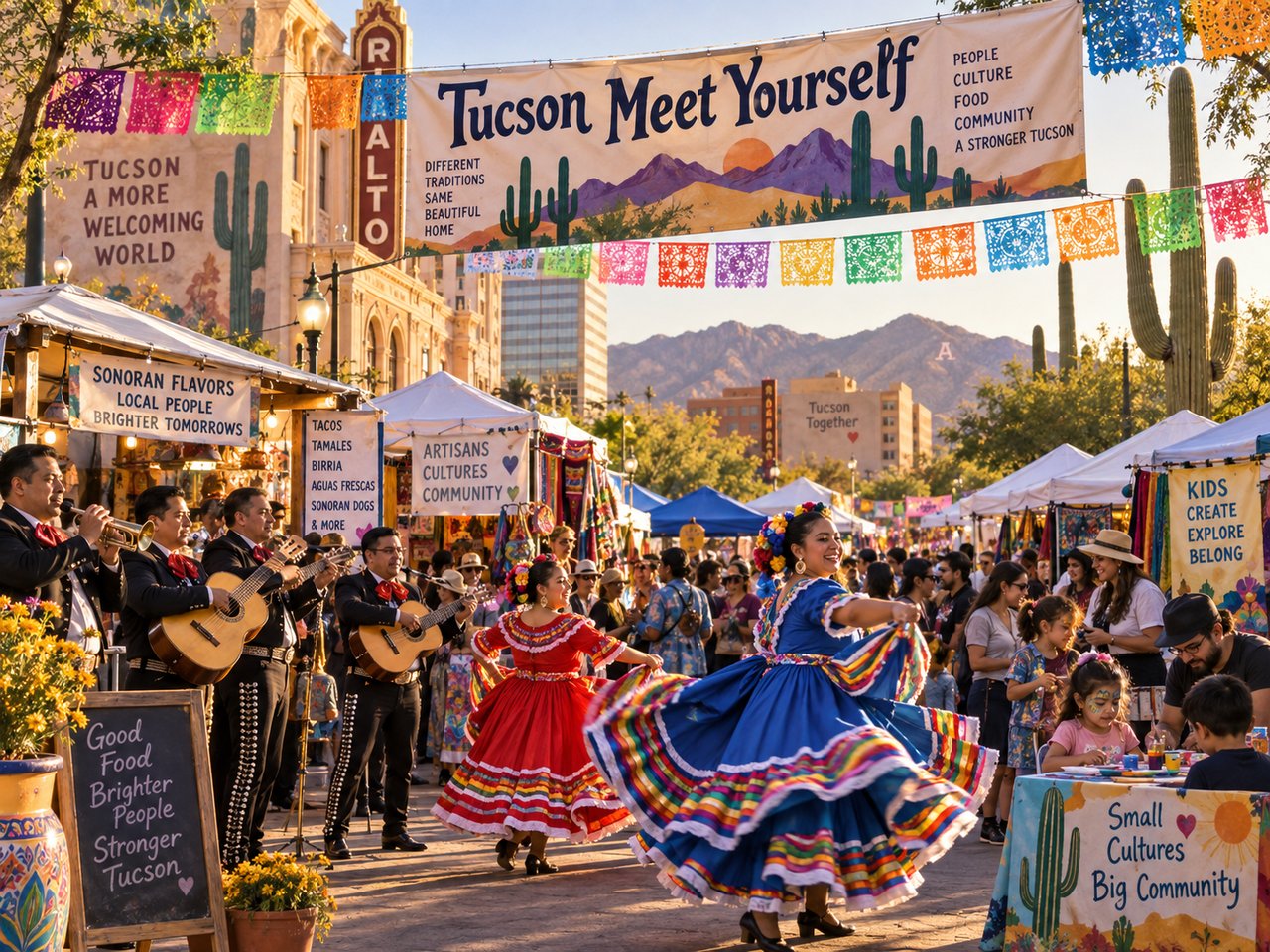
If you've been going to Tucson Meet Yourself for more than a couple of years, you already have a route. You know which entrance to use off Church Avenue, you know the churro line moves faster after 7 p.m., and you know that the corner of Congress and Stone is just a corner you cut through to get somewhere better. This October, that corner stops being a shortcut.
The reason has less to do with festival growth than with a gap 2,300 miles away. For the first time in its history, the Smithsonian Folklife Festival did not take place on the National Mall this July. The space was used instead for the "Great American State Fair," part of the federal government's Freedom 250 programming marking the country's semiquincentennial. In its place, the Smithsonian built something it had never done before: a traveling version of itself, landing at roughly 40 local festivals across the country under the banner "Of the People: The Smithsonian Festival of Festivals." Tucson Meet Yourself is one of the 40. That's not a sponsorship logo on a banner. It's the closest thing most of us will get this year to the actual Smithsonian Folklife Festival, and it's reshaping the ground the local festival sits on.
The Tent That Became a Stage
For years, Culture Kitchen was the kind of thing you stumbled into rather than planned around: a live cooking demonstration tucked into a tent, easy to miss if you weren't already looking for it. TMY senior advisor Dr. Maribel Alvarez has described it as understated, almost an afterthought next to the food booths. Smithsonian funding changed that calculus. This year, Culture Kitchen has a built stage at the corner of Congress and Stone designed to look like a 1950s diner, designed by artist Sarah Polzin. Alvarez put the reasoning simply: the festival is a lot more than just eating the food, it tells the story of the food. That corner is also where author and historian Jeff Chang, who wrote the biography of Bruce Lee, is expected to appear as a guest speaker.
If your habit has been to treat that intersection as a pass-through, plan on it being a destination this year, and plan on the crowd that comes with a destination.
Three Rooms That Weren't There Last October
The diner stage isn't an isolated addition. It sits inside a larger new footprint called the Of the People Village, and none of its three components existed at TMY in any previous year:
- Folklife Here: Narrative & Dialogue Stage — facilitated conversations on work, culture, belonging, and public life, run as actual dialogue rather than performance.
- Occupational Folklife Demonstrations — workers from Tucson-specific trades showing how their skills get learned and passed down, not a general craft fair table.
- Citizen Journalism Summit & Community Media Hub — a gathering of local journalists, independent media makers, and students built specifically for this year's programming.
There's also a smaller addition worth knowing about if you haven't run into it yet: an interactive kiosk called "We Hold These Truths," created by local interdisciplinary artist and zine maker Ames Meeks, where residents record their own interpretation of that phrase. It's been touring Tucson events since it debuted at the Tucson Folk Festival in April, and TMY is its next stop.
None of this is decoration bolted onto the festival you remember. Alvarez has said the Smithsonian's involvement pushed TMY to reassess its layout and atmosphere altogether, and her own words to a reporter were direct: people are going to see some big changes.
The Preview Already Happened
If you want proof this collaboration has real money behind it and isn't just a press release, it already delivered once. On August 28, the Fox Tucson Theatre hosted a free concert by Rissi Palmer, co-presented by the Fox, the Smithsonian's Folklife Festival, and TMY, funded through the Smithsonian's "Our Shared Future: 250" initiative. Palmer, known for her work broadening the conversation about Black artists' contributions to country music, used the evening for music and storytelling rather than a straight set, and the concert was explicitly framed as an early celebration of this year's TMY theme of honoring the people and traditions that shape communities. If you missed it, that's fine. It functioned as a preview, and the show itself is over. What it proves is that the partnership has been producing programming for months, not weeks, ahead of the October weekend.
Why This Configuration Won't Repeat
Here's the part that changes how you should think about this year rather than just what to expect from it. Alvarez has pointed out that TMY's own origins trace back to just a few years after the Smithsonian's first Folklife Festival in 1967, and that the Smithsonian's curatorial approach has always been the standard the Tucson festival aspired to. Partnering directly with that same institution isn't an incremental sponsorship bump. It's a one-time alignment tied to a national anniversary that will not recur next October. The funding stream is attached to the country's 250th birthday, not to an ongoing TMY budget line. Whatever becomes permanent in the festival's footprint after this year will be TMY's own choice to keep, not a continuation of Smithsonian money.
That means the shape of the festival on Friday, October 16 through Sunday, October 18 exists in a configuration that has never happened before and, in this exact form, won't happen again.
Recalibrating Your Usual Route
For anyone who has the logistics memorized, the basics haven't moved. The festival still centers on Jácome Plaza in front of the Joel D. Valdez Main Library, extending along North Stone Avenue, North Church Avenue, and East Pennington Street between Congress and Alameda. It's still free. The Sun Link streetcar's Church and Congress stop is still the closest transit access point, and in past years free metered street parking has kicked in Friday evening and run through the weekend, with garage options at the Public Service Center on East Alameda and El Presidio on West Alameda for anyone who'd rather not deal with street spots.
What's worth adjusting is where you allocate your first hour:
- Build in extra time at Congress and Stone. The diner-set Culture Kitchen stage is a fixed structure now, not a tent you can walk past, and fixed structures create bottlenecks that tents don't.
- Give the Of the People Village a real look even if you've never bothered with the demonstration booths before. The Narrative & Dialogue Stage and the Occupational Folklife Demonstrations are new footprint, not repackaged old programming, so skipping them the way you might have skipped a familiar exhibit means skipping something you haven't actually seen.
- If you're bringing someone new to the festival this year, know that the version they experience will genuinely be different from the one you'd describe from memory. That's not exaggeration for the sake of a headline. It's the direct result of a national funding initiative that only exists because of a canceled event on the other side of the country.
Whether you've gone every October since the Griffiths started this thing in 1974 or you're catching your first one this fall, the festival occupying downtown this year is a specific, non-repeating version of itself. It's worth walking the extra corner to see what that actually looks like.
Saguaro Ranch keeps its own kind of attention on what makes a place worth protecting, the traditions as much as the land. If that instinct for where to look closely resonates with how you want to live, Saguaro Ranch would welcome the chance to show you around. Schedule a Private Visit.